

Looking for a yes or no answer? The Venue FAQ answers the questions buyers ask most, such as whether Soundcheck has ranked holds or structured tech specs.
Soundcheck’s own terms
| Term | What it means | In Soundcheck |
|---|---|---|
| Venue record | Your organization’s saved copy of a place: address, type, capacity, contacts, logistics, amenities, notes and files. | Venues in the sidebar. Your edits stay in your organization. See The venue record. |
| Shared directory | Soundcheck’s catalog of public venues that any organization can add from. | The Add from directory group when you search Venues, and city packs. See Your venues. |
| City pack | A set of directory venues in one city, added in one go. | Starter packs → Venue city packs. See Add a whole city. |
| Stage | A room, stage or space at a venue you book on its own, with its own capacity, stage size, house tech and site plans. | The record’s Stages tab. Every saved venue starts with Main. See Stages. |
| Booked stage | A stage a gig is booked on. | The Stages card on the gig’s Venue tab. See Book a gig on stages. |
| Site plan | A floor plan, stage plot or load-in route uploaded to a stage. | Stage Site plans. Everyone on a gig booked on that stage can open them. |
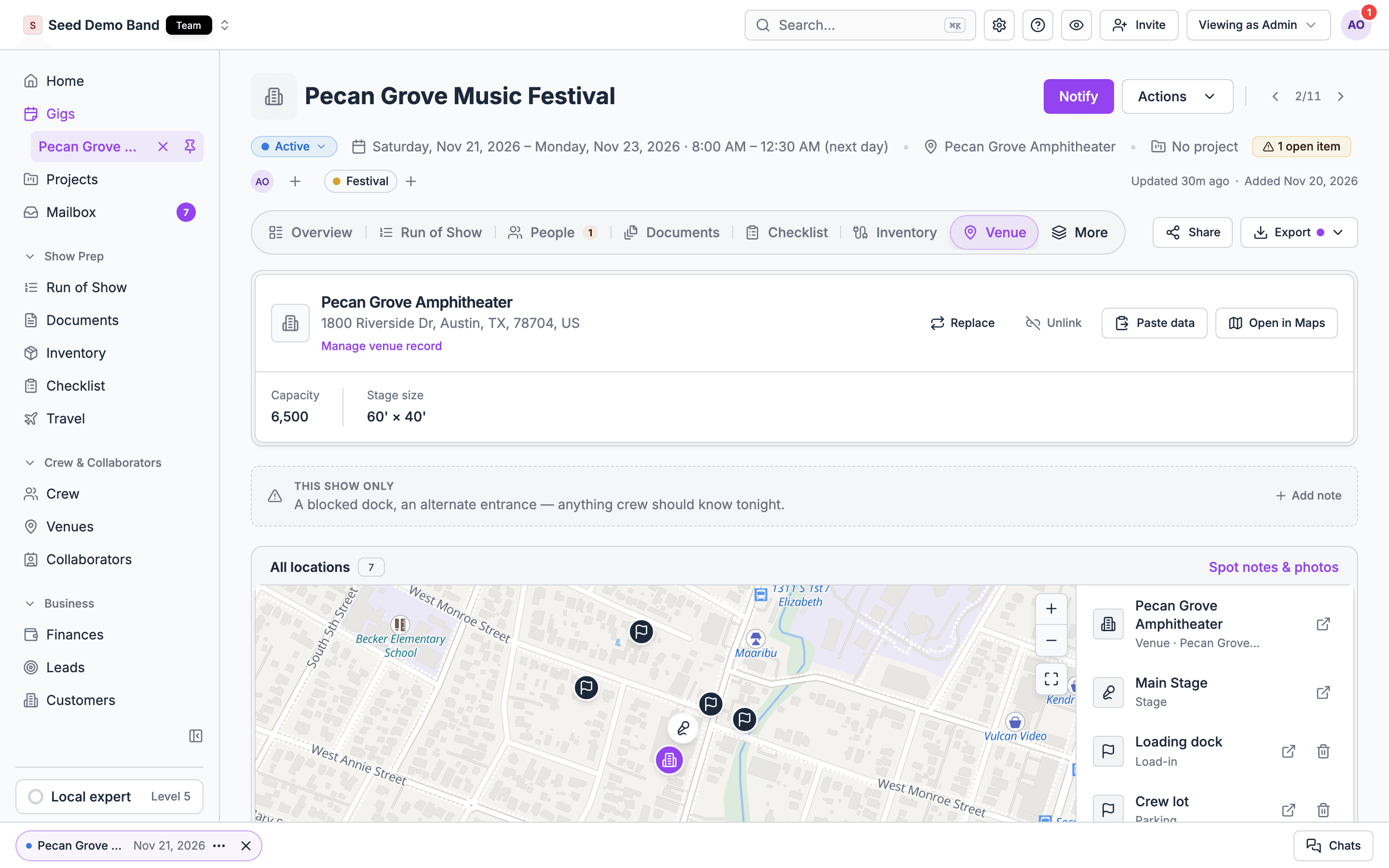
| Key spot | A place crew need to find on arrival, pinned on the venue’s map with notes and photos. | The record’s Key spots tab and the gig’s All locations map. See Key spots. |
| Crew note (on a spot) | What a crew member learned about a key spot, kept for the next crew at that venue. | Crew notes on a spot. See Crew notes on spots. |
| Crew advance | The venue’s reusable arrival details. | The Crew advance section of the record’s Overview. The word “Crew” follows your organization’s term for crew. |
| Load-in & access | The seven arrival fields every gig at a venue starts with: Access code, Dock, Load-in, Load-out, Elevator, Parking and Green room. | Load-in & access on the gig’s Venue tab. See The gig Venue tab. |
| Per-show override | A different value for one Load-in & access field on one gig. The venue default stays as it is. | Click the field and choose Save. It shows a This show badge. See Per-show changes. |
| Show notes | Notes for one gig that don’t fit a field. | This show only on the web, Show notes in the app. Up to 500 characters each. See This show only notes. |
| Fill from web | Research that reads the venue online and proposes details and stages for you to review. | Fill from web on the record. Nothing saves until you apply it. See Fill blanks from the web. |
| Venue intelligence | Research of the venue’s official website, confirmed by a manager, that carries to later gigs. | The Venue intelligence panel on the gig’s Venue tab. See Venue intelligence. |
| Listing claim | Proving you run a business in the public directory, so you can manage its public listing. | Verify with a work email at the listing website’s domain, then edit Public listing details. See Claim your directory listing. |
| Your status | Your team’s working label on a venue. | Your status: preferred, backup or avoid. |
| Load-in map | The venue file that shows crew the route in. | Pick it on the record’s Files tab. Call sheets and day sheets print it. See Files. |
Venue documents
| Term | What it means | In Soundcheck |
|---|---|---|
| Tech pack (venue technical rider) | The venue’s document describing its stage, rigging, power, in-house gear and rules. | Upload it on the record’s Files tab, or as a stage’s Site plans. Key facts go in Stage size, House tech, Restrictions and Crew advance. Soundcheck doesn’t track tech pack versions or remind you when one is out of date. |
| Rider | The act’s list of technical and hospitality requirements. | No structured rider. Attach it on the gig’s Documents tab. |
| Stage plot | A drawing of where performers and gear sit on stage. | A file on the record’s Files tab (pick it as the Stage plot) or a stage’s Site plans. No built-in stage plot editor, and the stage plot doesn’t print on call sheets. |
| Day sheet | The one-page schedule and contacts for a show day. | The Day sheet PDF. It prints the gig’s load-in details and the venue’s load-in map. See Exporting. |
| COI (certificate of insurance) | Proof of liability insurance, usually naming the venue as additional insured. | Upload it to the record’s Files tab. Soundcheck doesn’t track COI expiry or which vendors have sent one. |
| BEO (banquet event order) | The venue’s internal order sheet for food, beverage, room setup and timings. | No equivalent. Use the run of show for timings and attach the order as a file. |
Advancing and arrival
| Term | What it means | In Soundcheck |
|---|---|---|
| Advance / advancing | Confirming every show detail with the venue before the date. | The venue’s Crew advance holds the reusable answers, and Load-in & access and show notes hold this show’s. There’s no advance form the venue fills in. |
| Load-in / load-out | Moving gear into the venue before the show and out after it. | Load-in and Load-out fields in Load-in & access, and the load in and load out key times on the gig. |
| Dock | The loading bay where trucks unload. | The Dock field, and a key spot of kind Load-in. There’s no structured dock height or bay count; type them into Dock. |
| Curfew | The time music or the event must stop, often with fines after it. | A Restrictions tag on the venue, and the curfew key time on the gig. Soundcheck doesn’t warn when a schedule runs past it. |
| Green room | The backstage room for performers. | The Green room field (with directions), Dressing rooms, and a key spot of kind Green room. |
| House crew / house tech | Venue employees who work every event in the room. | House tech on a stage lists the venue’s gear, not its people. Add house staff as collaborators on the venue. |
| Minimum call | The minimum hours a union crew member is paid for when called. | Not applied. See the staffing glossary. |
Rigging and power
| Term | What it means | In Soundcheck |
|---|---|---|
| Grid / trim height | The height of the overhead rigging structure, and the working height lights or truss hang at. | No structured field. Put it in the stage’s Notes or Stage size. |
| Rigging point | A rated point in the ceiling where a hoist or truss can hang. | No structured field. Upload the rigging plot to the stage’s Site plans. |
| Working load limit (WLL) | The maximum load a rigging point or beam is rated to carry. | No structured field. Keep it in the rigging plot or the stage’s Notes. |
| Tie-in / company switch | The venue’s power disconnect where touring power distribution connects. | No structured power fields. Pin it as a key spot of kind Power, with notes and a photo. |
| Camlock | A heavy-duty single-pole power connector used for large power feeds. | No equivalent field. Note connector types on the Power key spot or the stage’s Notes. |
Holds and booking
| Term | What it means | In Soundcheck |
|---|---|---|
| Hold | A provisional reservation of a date, ranked against other holds. | Not available. Soundcheck doesn’t offer holds today. A draft gig booked on a stage is the closest pencil. See Holds. |
| First hold, second hold | The rank of a hold; the first holder has the right to confirm before the next. | Not available. Draft gigs on the same stage don’t have a rank. |
| Challenge | A request from a lower hold asking the higher hold to confirm or release by a deadline. | Not available. |
| Avails | The dates a venue has open to book. | No avails list or export. The calendar shows booked gigs. |
| Confirm | Turning a hold into a booked date, usually with a signed contract. | Publishing a draft gig. See Drafts and publishing. |
| Double booking | Two events in the same room at the same time. | Booking a stage that another gig already uses warns This stage is already booked, drafts included. It never blocks. See Overlaps. |
| Four-wall deal | The venue rents the empty room; the renter supplies staff and keeps the box office. | No equivalent. |
| Buyout | A booking where one client takes the whole venue. | No equivalent. Book the gig on every stage. |
| Dark day | A day the venue has nothing booked. | No equivalent. A day with no gigs on the calendar. |
| Routing | The order and path of venues on a tour. | Group the gigs in a project. Each gig links its own venue. |
Venue money
| Term | What it means | In Soundcheck |
|---|---|---|
| F&B minimum | The minimum food and beverage spend a client commits to. | No equivalent. |
| Settlement | The end-of-night accounting between the venue, promoter and act. | Not part of Venue. See Show settlement in Finances. |
| Guarantee vs. percentage | A deal where the act gets a fixed fee or a share of receipts, whichever is higher. | Not part of Venue. See Billing terms and deals. |
Worked example: entering a club’s tech pack
The Lantern Room sends a 12-page tech pack PDF before your first show there. Here’s where each part goes.| In the tech pack | Where it goes |
|---|---|
| The PDF itself | The record’s Files tab |
| Main room: 24’ × 16’ stage, 450 capacity | The Main stage’s Stage size and Capacity |
| Second room: 120 capacity, no PA | A second stage, Back Room, with its Capacity |
| Console, PA, monitor wedges | House tech on each stage |
| Load-in through the alley door, code at the box office | Load-in and Access code under Crew advance |
| Alley door and company switch locations | Key spots of kind Load-in and Power, pinned on the map |
| 11 PM curfew, no haze | Restrictions tags |
| Load-in diagram | The record’s Files tab, picked as the Load-in map |
Questions this page answers
- What does Soundcheck call a room, a dock or a tech pack?
- Does Soundcheck have ranked holds, challenges or avails?
- Where do rigging and power details go?
- What is a per-show override?
- Does the stage plot print on the call sheet?
Related
Venue
Start here.
Venue FAQ
Yes or no answers to the questions buyers ask.
The venue record
Everything on one venue’s page.
Run of show glossary
Show-calling and schedule terms.