

This page covers the first two. For the third, see Career record.
Your business type decides the words and, for the route, the content. A band, a production company and a venue do not grow the same way, so they do not climb the same ladder. If business types are new to you, read The show model first.
Workspace levels
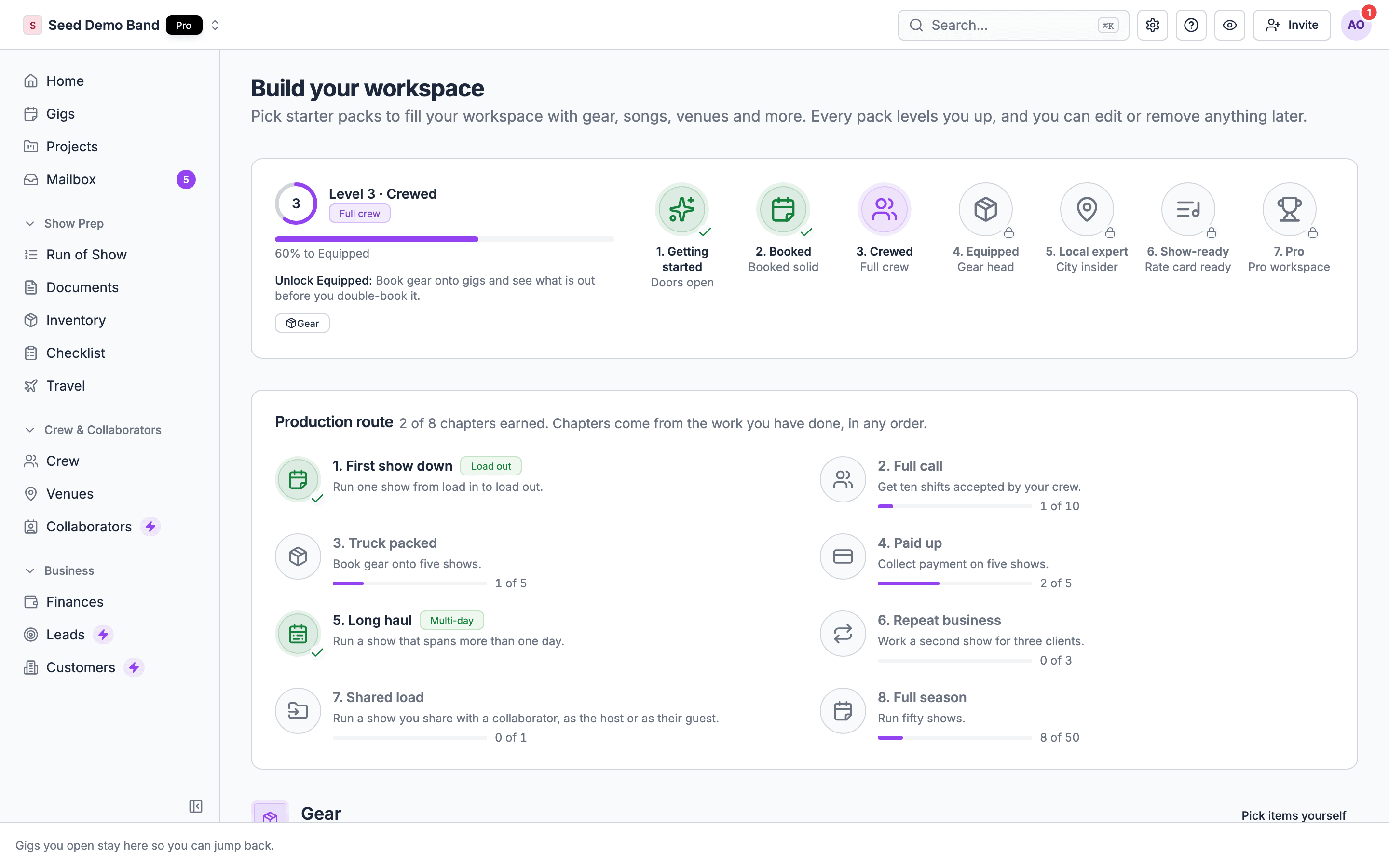
A level says how much of your workspace is set up. There are seven, and every organization starts at level 1. Owners and admins see the current level on the Build your workspace card on Home, at the bottom of the sidebar, and on the Build your workspace page. When you reach a new level, Soundcheck shows the badge you earned and what the level gives you.What each level needs
Each level looks at one or more setup areas. An area is done when it holds enough of your own records, or when you have added a starter pack for it.
Three rules apply to every organization:
- Levels are reached in order. Level 5 counts only when levels 1 to 4 are reached.
- A level skips what does not fit your business type. A venue does not keep a list of other venues or of hotels, so Local expert has nothing to ask of a venue and is passed once the levels before it are reached. For a venue, Show-ready needs one agreement only.
- Sample records do not count. The sample gig counts once toward level 2. Sample crew, sample gear and the sample venue count toward nothing.
Level names by business type
The requirements are the same for everyone. The names and badges follow your business type.- Talent
- Production
- Venue
Routes
Levels end when setup does. The route is what your organization earns after that, from the shows it has run. A route is a list of chapters. Each chapter has a goal, a target and a badge. A chapter is earned when your count reaches its target.What counts
Every chapter counts played gigs. A gig is played when its last day has passed and it is not a draft, a template, a sample, cancelled or deleted.The route for each business type
Each business type has its own chapters, in its own order.- Talent
- Production
- Venue
How chapters work
- Chapters are earned in any order. Shows do not happen in a fixed sequence, so one chapter never blocks another.
- A chapter stays earned. If you delete a gig later and the count drops, the badge stays.
- A new chapter is celebrated on the web. Soundcheck shows the chapter and its badge for seven days after you earn it, until you close it. Chapters an organization had already earned before routes existed are marked earned without a celebration.
- The shared-gig chapter appears when you can earn it. Sharing a gig with collaborators is in early access. The chapter is listed once sharing is on for your organization or you already have a shared gig. Until then your route has seven chapters, numbered without a gap.
Where to find your route
Related
Career record
The chapters a person earns from the gigs they work, across every organization.
The show model
The six parties on every show, and the three business types.
Signup and organization setup
The starter kit, the setup checklist and the sample gig.
Your first 7 days
A week-long path from an empty account to a staffed first gig.